A dripping or sputtering tap can come from a worn faucet cartridge, a damaged seal, debris at the aerator, a failing shutoff, or a supply problem elsewhere in the home. The most reliable first step is to identify whether the symptom affects one fixture or several before replacing parts. This guide to faucet repair in Ottawa explains common causes, safe checks, and when to ask a plumber to inspect or replace the fixture.
The uploaded keyword snapshot shows a focused opportunity: “faucet repair Ottawa” is estimated at 110 monthly searches with keyword difficulty 8, and “plumber for faucet repair” at 110 searches with difficulty 10. The file is a third-party competitor snapshot, not a live forecast or a promise of rankings. These terms suggest homeowners search for local help with a specific fixture problem, so the page is designed around diagnosis and service decisions rather than generic plumbing promotion.
Key Takeaways
- A faucet that drips after shutoff often has a worn internal seal or cartridge, but the model determines the correct repair.
- Low flow at one tap points to a local restriction more often than low flow at every fixture; compare before concluding.
- Do not force stuck shutoffs, corroded aerators, or handles; a small part can turn into a larger leak.
- Repair-versus-replace depends on part availability, body condition, recurring failure, and the full installed scope.
- A leak under a sink or inside a wall deserves prompt attention even when the faucet still works.
A quick way to narrow the cause
Why faucets drip, sputter, or feel stiff
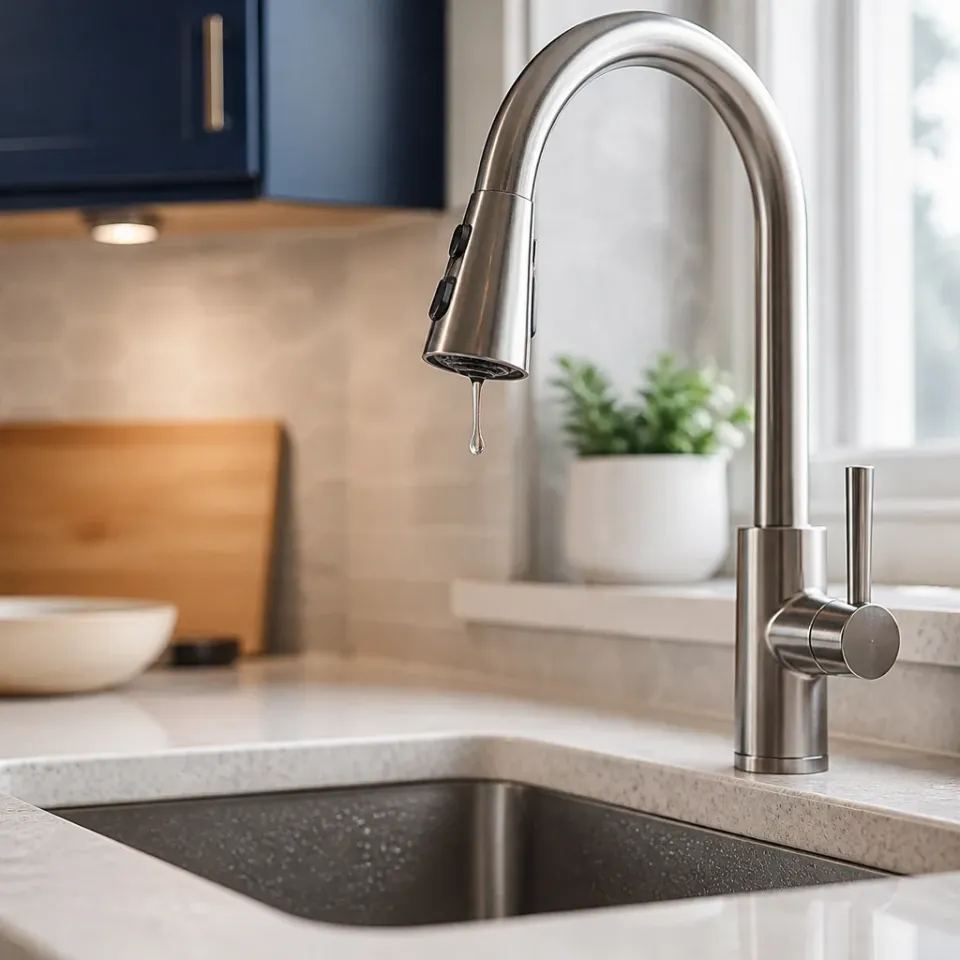
Faucets open and close water passages through seals, cartridges, discs, washers, and internal valves. Repeated movement, sediment, corrosion, mineral deposits, or age can affect those parts. A drip from the spout after the handle is closed may indicate that an internal seal is no longer stopping water completely. Water around the handle or base can have a different source, such as a worn O-ring, loose connection, or water that has splashed onto the deck.
A noisy or sputtering faucet can involve air in the supply, debris, a partly closed shutoff, or a pressure change. A sudden change across the whole home should not be diagnosed by changing one faucet cartridge. Compare another sink and shower, and note whether both hot and cold sides are affected. If only one tap has weak flow, the restriction may be localized; if multiple fixtures change together, ask a plumber to investigate the supply or distribution system.
Water under the sink may not originate in the faucet at all. It can come from a supply hose, shutoff valve, drain connection, sink strainer, or water that ran down the counter. Dry the cabinet only if it is safe, place a container beneath a drip, and observe from outside the cabinet. For drain-side leaks and sink-basin issues, see our separate Ottawa sink repair guide; faucet supply and drain connections are different systems.
| What you notice | Possible area | Useful clue |
|---|---|---|
| Drip from spout with handle closed | Cartridge, washer, valve seat, or internal seal | Does it stop after a few seconds, or continue steadily? |
| Water around the handle | O-ring, cartridge seal, or water splashed on the deck | Dry the area and observe when the handle is operated. |
| Wet cabinet below the tap | Supply hose, shutoff, faucet mounting, or drain | Does moisture appear while water runs or after the basin drains? |
| Low flow at one faucet | Aerator, cartridge, local shutoff, or supply connector | Compare hot and cold and another nearby fixture. |
| Several fixtures lose flow | Broader supply or distribution issue | Note whether the change was sudden and affects both temperatures. |
Faucet types and the parts that wear
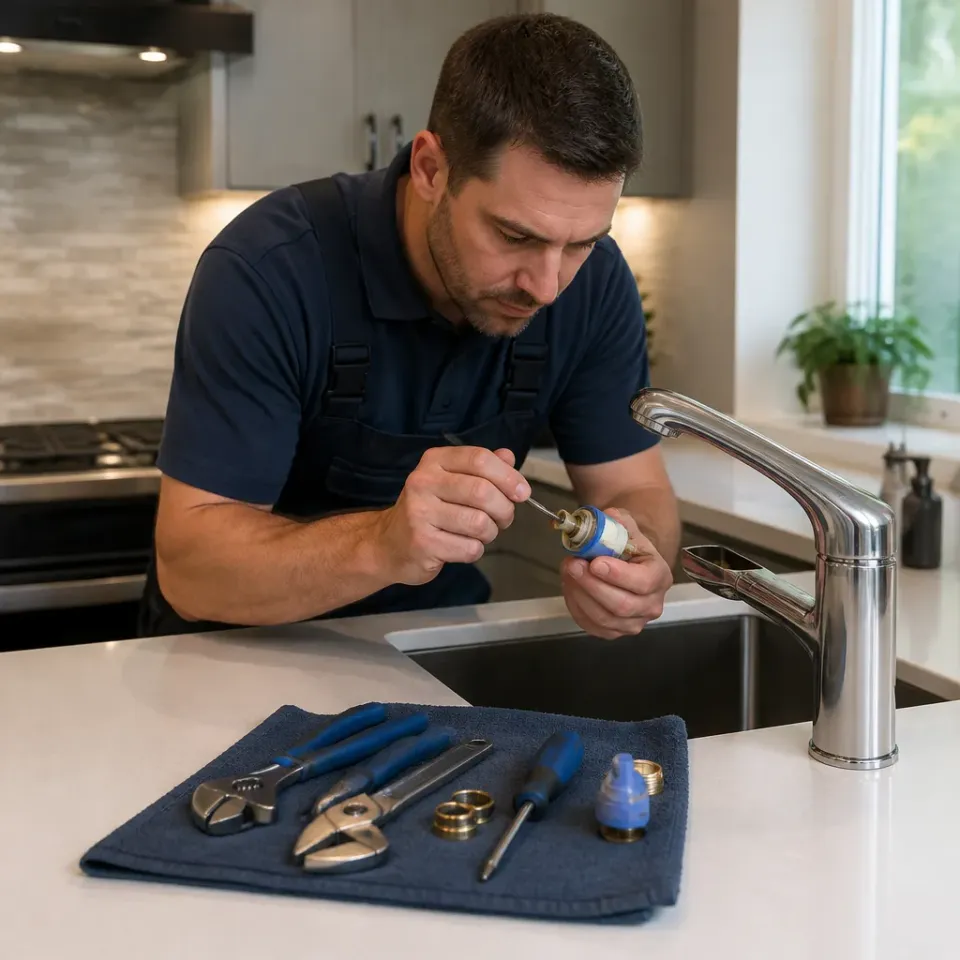
A faucet's repair parts depend on its design. Single-handle models commonly regulate temperature and flow through a cartridge or a ceramic-disc assembly. Two-handle faucets may have separate hot and cold cartridges or compression-style stems. Pull-down kitchen faucets add a hose and spray head; touch or thermostatic models can include electronics or specialized valves. The external shape alone may not reveal the correct internal part.
Before ordering a cartridge, look for the manufacturer's name, model number, installation paperwork, or a product label. Handle shape and finish are not reliable identifiers. Photograph the faucet and record whether it has one or two handles, a pull-out spray, or a temperature limiter. If access is difficult or the model is unknown, a plumber can identify the assembly without turning a small repair into a damaged handle or stripped fitting.
The aerator at the end of the spout can collect sediment and reduce flow. If it removes easily, a gentle rinse may clear loose debris; use a soft cloth to protect the finish and avoid forcing a stuck aerator with metal tools. Do not assume that every slow tap needs a new cartridge. A local restriction, partly closed stop valve, or supply issue can produce similar symptoms.
Safe checks before calling a faucet repair plumber
First determine whether water is actively escaping. If a hose is spraying, a cabinet is filling, or water is reaching an adjacent room, close the nearest shutoff only if it turns normally. Many older valves can seize or begin leaking when forced. If the valve is stiff, corroded, or dripping, do not grip it with pliers; shut off the home's main water supply only if you can do so safely and know its location, then call for assistance.
For a slow spout drip, note whether it continues with the handle fully closed and whether it is on the hot side, cold side, or both. For weak flow, compare a second faucet and test hot and cold separately. Check whether the problem began after water service, a renovation, or a period of low use. Do not remove a handle or cartridge unless you know the exact shutoff works and you have the correct model-specific instructions.
Keep cleaning products and tools out of the sink cabinet if it is wet. Avoid mixing household chemicals, and do not use a flame or heat gun to loosen a corroded fitting. Water near an electrical outlet or appliance is a reason to stay clear and arrange appropriate help. If the faucet is only dripping at the spout, a towel or container can catch water temporarily, but it is not a repair and should not hide a growing cabinet leak.
Contain active water
Use a container or towel if safe, and protect stored items without reaching into a wet electrical area.
Try a shutoff only if it moves freely
Do not force a seized stop valve. If water is uncontrolled and the stop fails, seek prompt help.
Compare nearby fixtures
Check another tap and compare hot and cold flow to see whether the symptom is local or broader.
Record the faucet details
Take a photo, note the brand or model if visible, and describe when the drip or pressure change occurs.
Leave uncertain disassembly to a pro
Model-specific parts and fragile fittings can be damaged by improvised tools or incorrect reassembly.
Low flow: faucet problem or supply problem?
A single tap with reduced flow suggests starting with that fixture: the aerator, cartridge, local shutoff, or supply connector may be restricted. If hot flow is weak but cold is normal, compare other hot taps and note whether the water heater or another shared component could be involved. If several faucets and showers change at the same time, a single faucet repair is unlikely to solve the whole issue.
A faucet that spits air briefly after plumbing work or a water interruption may behave differently from one that has had steadily declining flow for weeks. Do not remove screens or internal parts without checking the manufacturer's directions. Sediment can shift when water service changes, and a cartridge may be damaged if debris is forced through it. A professional can assess the tap and determine whether the supply, shutoff, or faucet itself needs service.
Water pressure and drain performance are not the same thing. A faucet can have normal supply pressure while the sink drains slowly because the trap or waste pipe is restricted. If the basin fills while the tap works normally, our guide to safely clearing a slow drain addresses the drain side. If pressure is low throughout the home, review our low-water-pressure troubleshooting guide and arrange an assessment if the change is sudden or severe.
Repair the faucet or replace it?
Repair can be a sensible choice when the faucet body is sound, the leak has a clear source, and the correct cartridge, seal, or handle parts remain available. A replacement may be more practical if the faucet body is cracked or heavily corroded, the finish or mounting is failing, parts cannot be sourced, or multiple repairs have not stopped the problem. The choice should take into account the fixture, the sink or countertop opening, shutoff condition, and what access is like under the cabinet.
For a replacement, consider whether the new faucet fits the existing hole pattern, deck thickness, supply connections, and sink depth. A pull-down spray head or high-arc spout can affect clearance, while older sinks may have a different handle spacing from current models. If cabinets or counters are part of a renovation, coordinate fixture choices with the contractor before ordering; changing the tap late can mean extra work or incompatible openings.
| Repair often fits when… | Replacement may fit when… | Confirm before approving |
|---|---|---|
| A known cartridge or seal has failed. | The faucet body or mounting is damaged. | Correct part number and compatibility. |
| The faucet is otherwise stable and parts are available. | Leaks have returned after appropriate repairs. | Whether the shutoff valves and supply hoses are sound. |
| The finish and function still meet household needs. | The fixture is part of a planned kitchen or bath update. | Hole pattern, reach, clearance, and connection type. |
| The repair can be tested without opening finished surfaces. | The faucet is obsolete or difficult to service. | Removal, disposal, installation, and warranty scope. |
When a faucet leak needs urgent attention
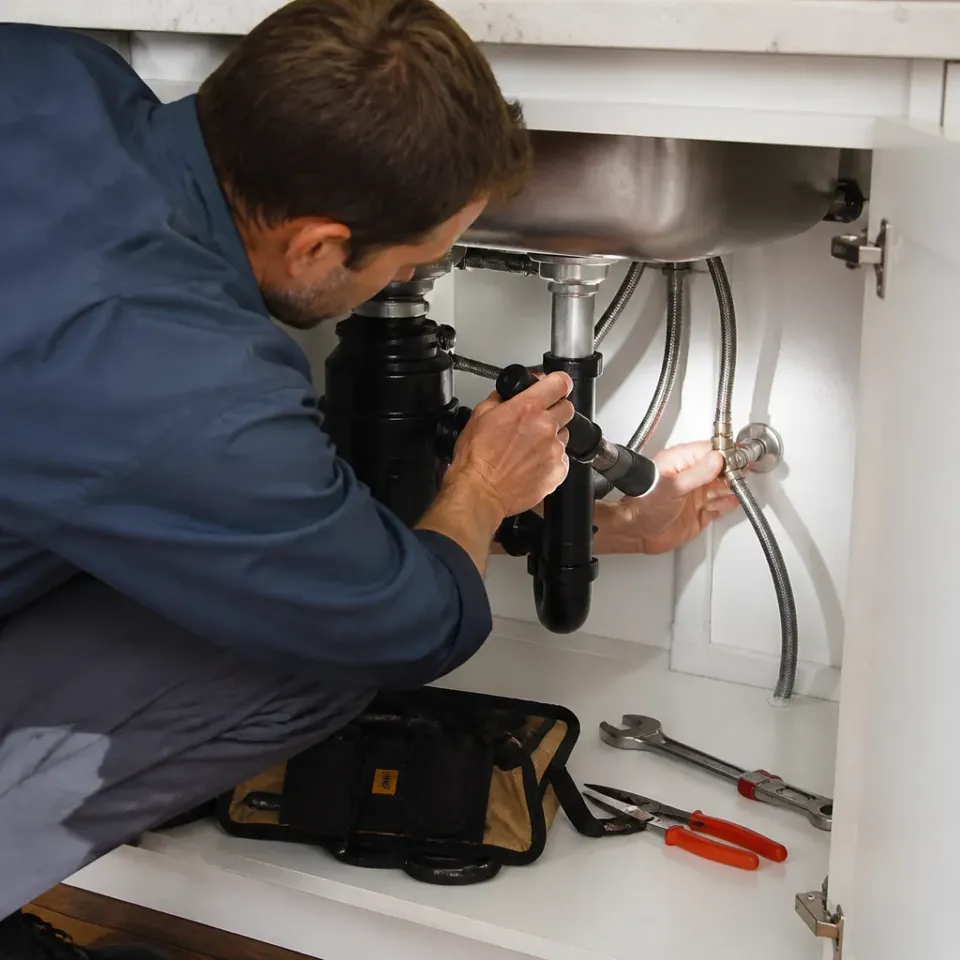
A slow drip at the spout is usually a repair appointment, not an emergency call. A failed braided supply hose, broken shutoff, leaking connection inside a wall, or water spreading through a cabinet or ceiling is different. Stop using the fixture, keep people away from wet electrical equipment, and close the nearest shutoff only if it works safely. If you cannot stop the water, know where the main shutoff is, or see water near electricity, seek prompt professional help.
If water has reached the floor, take photos only when it is safe, move belongings out of the wet area, and note when the leak started. Do not open walls or cabinets around a suspected electrical hazard. Our Ottawa hidden-leak guide explains warning signs that deserve further inspection. For an active plumbing failure, use the steps in our plumbing emergency checklist.
What affects faucet repair cost in Ottawa?
A service call to identify a drip is not the same scope as replacing a cartridge, freeing a corroded handle, repairing a shutoff, or removing a faucet from a tight cabinet. Cost depends on the model and availability of parts, access, whether one or both sides need work, the condition of supply hoses and valves, and whether water damage has affected the cabinet or surrounding finish. There is no single reliable quote that applies to every Ottawa home.
Ask whether the estimate includes diagnosis, the part, labour, testing, cleanup, and warranty. Confirm any service-call minimum or after-hours rate before booking. For replacement, ask whether the price covers the faucet, removal, disposal, new connections, testing, and any modification needed to the sink opening. If hidden corrosion is possible, ask how additional work will be approved and priced.
Use the faucet brand and model, a photo of the tap and under-sink space, and a short description of the leak to request a more useful initial estimate. Do not buy a replacement cartridge based only on a similar product photo. The cost of a wrong part can include another visit and additional labour, while a plumber may be able to identify the correct assembly during the assessment.
Choosing faucet repair in Ottawa
Ask the plumber whether the visit is for diagnosis, repair, or full replacement, and what information they need about the faucet. A clear estimate identifies the likely part, the work included, and any exclusions. Ask what happens if the internal fitting is seized or a shutoff valve fails during service. If the faucet is part of a bathroom or kitchen remodel, confirm the new fixture's compatibility before ordering.
In Ontario, the plumber trade is regulated as a compulsory skilled trade. Skilled Trades Ontario provides information about the Plumber 306A trade and a public register for checking credentials. Confirm that the person doing the work is appropriately qualified and that the business explains its insurance and warranty terms.
If you need a professional diagnosis or repair, Ottawa faucet repair professionals can assess the fixture, confirm compatible parts, and explain whether repair or replacement is appropriate. Keep the model details and service record for future maintenance.
Prevent repeat faucet problems
Avoid overtightening a handle to stop a drip; excessive force can damage the cartridge or stem. Clean faucet finishes and aerators according to the manufacturer's instructions, and do not use harsh cleaners that may damage plating or seals. If a tap begins sputtering after plumbing work, note the timing and check whether other fixtures behave the same before attempting to dismantle it.
Include supply hoses and shutoff valves in regular under-sink visual checks. Keep the cabinet dry and avoid storing items so tightly that a small leak cannot be seen. If you discover moisture, identify whether it appears when the faucet runs, when the basin drains, or even when the fixture is idle. That distinction helps the repair person separate faucet supply leaks from sink drain leaks.
When a faucet problem is part of a larger kitchen project, plan the fixture early with the sink, counter, and cabinet layout. This Ottawa kitchen renovation planning guide is a useful companion for homeowners coordinating fixture decisions with a broader update. For smaller work, our Ottawa faucet and toilet upgrade guide covers model fit, installation scope, and handover questions.
A successful faucet repair fixes the actual failure and leaves the sink dry under normal use. When you know what changed, which part was serviced, and what to monitor, a small repair becomes easier to manage and less likely to turn into a hidden cabinet or floor problem.