Key Takeaways
- Tank water heater replacement in Ottawa costs roughly $1,500–$3,500 installed; tankless runs $3,000–$6,500.
- Most tank water heaters last 8–12 years; tankless units last 15–20 years.
- Replace (don't repair) if the unit is leaking from the tank, over 10 years old, or the repair exceeds 50% of a new unit's cost.
- Tankless heaters use 24–34% less energy for moderate-use homes and never run out of hot water.
- Ottawa's hard water shortens tank life — annual flushing protects your investment.
Repair or Replace Your Water Heater? The Short Answer
A failing water heater rarely picks a convenient time. One morning the shower runs cold, you spot a puddle in the basement, or the tank starts making a rumbling sound — and suddenly you are weighing a repair bill against the cost of a brand-new unit. The good news is that the decision is usually clearer than it feels in the moment.
Here is the rule professionals use: if your water heater is leaking from the tank itself, or it is more than 10 years old and the repair costs more than half the price of a replacement, you should replace it. If the unit is younger and the fault is a single component — a thermocouple, heating element, or thermostat — a repair is almost always the smarter spend.
This guide walks through the warning signs of a failing water heater, real 2026 water heater replacement costs, and how to choose between a conventional tank and a tankless system. If you would rather skip straight to a professional opinion, our Ottawa water heater repair and replacement team offers free written estimates.
7 Signs You Need a New Water Heater
Water heaters usually give warning signs before they fail completely. Watch for these red flags:
- Water pooling around the base — a leaking tank cannot be repaired and signals internal corrosion. This is the single most urgent sign.
- Rusty or discoloured hot water — brown or metallic-tasting hot water often means the tank is rusting from the inside.
- Rumbling or popping noises — sediment buildup hardening at the bottom of the tank, which reduces efficiency and stresses the steel.
- Not enough hot water — if you run out faster than you used to, sediment or a failing element is shrinking your usable capacity.
- Inconsistent water temperature — fluctuating hot and cold points to a failing thermostat or heating element.
- The unit is 10+ years old — even if it still works, an aging tank is on borrowed time and at growing risk of a sudden leak.
- Rising energy bills — an inefficient, sediment-clogged heater works harder and costs more to run every month.
How Long Should a Water Heater Last?
Lifespan depends heavily on the type of unit and your water quality. Ottawa's moderately hard water accelerates sediment buildup, which is the number-one factor in shortening tank life.
Average Water Heater Lifespan
Regular maintenance — flushing the tank annually and checking the anode rod every few years — can add years to a conventional heater. Tankless units benefit from a periodic descaling, especially in hard-water homes. If your unit is approaching the end of these ranges, it is wise to budget for replacement before it fails.
Water Heater Replacement Cost in Ottawa (2026)
Below are realistic installed prices for the Ottawa market in 2026. "Installed" means the unit, removal and disposal of the old heater, connections, and labour by a licensed plumber.
| Water Heater Type | Unit + Install (2026) | Best For |
|---|---|---|
| 40 gal electric tank | $1,500 – $2,400 | Smaller homes, 1–3 people |
| 50 gal gas tank | $1,900 – $3,500 | Average family homes, 3–4 people |
| Power-vent gas tank | $2,500 – $4,000 | Homes needing side-wall venting |
| Tankless (gas) | $3,500 – $6,500 | Endless hot water, space saving |
| Tankless (electric) | $3,000 – $5,000 | Smaller homes, no gas line |
| Hybrid heat pump | $3,500 – $6,000 | Maximum efficiency, warm utility rooms |
For a complete breakdown of plumbing prices across every service, see our Ottawa plumbing cost guide. Costs can rise if your installation requires venting changes, a gas line, an electrical panel upgrade, or bringing older plumbing up to current code.
Tank vs Tankless: Which Is Right for Your Home?
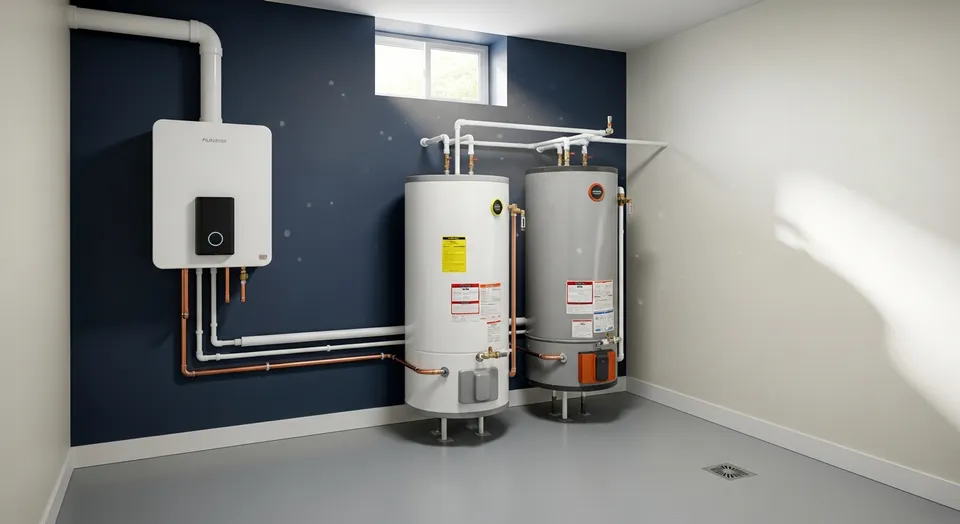
This is the biggest decision in any replacement. A conventional tank stores and continuously heats 40–60 gallons of water, while a tankless (on-demand) heater heats water only as it flows through the unit. Both have a place.
| Factor | Tank | Tankless |
|---|---|---|
| Upfront cost | Lower ($1,500–$3,500) | Higher ($3,000–$6,500) |
| Lifespan | 8–12 years | 15–20 years |
| Energy efficiency | Good | 24–34% better (moderate use) |
| Hot water supply | Limited by tank size | Endless |
| Space required | Large floor unit | Compact wall mount |
| Best for | Lower upfront budgets | Long-term savings, space |
According to the U.S. Department of Energy, tankless water heaters can be 24–34% more energy-efficient than storage tanks for homes that use around 41 gallons or less of hot water per day. For very high-demand households, the efficiency gain is smaller (8–14%), and you may need a larger or second unit to keep up.
If you are renovating a bathroom or kitchen at the same time, it is often the ideal moment to upgrade — see our bathroom renovation plumbing guide for how to plan it.
Gas vs Electric vs Hybrid: Choosing a Fuel Source
Beyond the tank-versus-tankless decision, the fuel source your water heater uses has a big impact on running costs, recovery speed, and what your home can support. Most Ottawa homes are set up for either natural gas or electric, and switching between the two adds cost — so your existing setup usually points you toward the most economical option.
Natural gas water heaters
Gas units heat water faster (better "recovery rate"), which matters for larger families who draw a lot of hot water in a short window. Natural gas is often cheaper per unit of energy than electricity in Ontario, so operating costs can be lower. The trade-offs are venting requirements, a gas connection, and the need for combustion air. Gas units must be installed by a licensed technician and vented correctly to prevent carbon monoxide risk.
Electric water heaters
Electric tanks are simpler, have no combustion or venting, and usually cost less to buy and install. They are a great fit for homes without a gas line. The downside is a slower recovery rate and, depending on electricity rates, potentially higher running costs than gas. They are also dependent on power — during an outage you will have only the hot water already in the tank.
Hybrid heat pump water heaters
A hybrid (heat pump) water heater pulls heat from the surrounding air to warm the water, making it dramatically more efficient than a standard electric tank — often two to three times more efficient. The U.S. Department of Energy notes heat pump water heaters can be significantly cheaper to operate over their lifetime. They cost more upfront and work best in a warm, well-ventilated space such as a furnace room, since they cool and dehumidify the air around them. For energy-conscious Ottawa homeowners with the right space, a hybrid can deliver the lowest long-term operating cost.
What Size Water Heater Do You Need?
Getting the size right is one of the most important parts of a replacement. An undersized unit leaves you with cold showers; an oversized one wastes energy keeping water you never use hot. For tank water heaters, sizing is based on the number of people in your home and your peak hour demand:
| Household Size | Recommended Tank Size | Notes |
|---|---|---|
| 1–2 people | 40 gallons | Suits condos and smaller homes |
| 3–4 people | 50 gallons | The most common Ottawa family size |
| 5+ people | 60–80 gallons | Or consider tankless for endless supply |
| High simultaneous use | Tankless or dual units | Multiple showers running at once |
For tankless units, sizing is measured by flow rate (litres per minute) and the required temperature rise. Ottawa's incoming municipal and well water is very cold in winter — often near 5°C — which means a tankless unit has to work harder to reach a comfortable shower temperature. This is exactly why professional sizing matters here more than in milder climates: an undersized tankless heater that performs fine in summer can disappoint on a January morning.
When a Repair Still Makes Sense
Not every water heater problem means replacement. If your unit is under 8 years old and not leaking from the tank, these repairs are usually worth doing:
- Thermocouple or pilot assembly (gas) — $150–$350. A common cause of "no hot water."
- Heating element (electric) — $200–$400. Restores capacity when you run out of hot water.
- Thermostat — $150–$300. Fixes temperature fluctuations.
- Pressure relief valve — $150–$350. A safety component that should never be ignored.
- Anode rod — $150–$300. Replacing it proactively prevents tank corrosion.
A licensed plumber can diagnose the fault and tell you honestly whether a repair is the right call. Our water heater repair service covers all tank and tankless brands.
What a Professional Replacement Involves
A standard tank replacement takes a licensed plumber 2–4 hours. The process includes shutting off the water and fuel supply, draining and removing the old tank, positioning and connecting the new unit, fitting the temperature-and-pressure relief valve and expansion tank, and testing for leaks. Gas units also require proper venting and a gas-tightness check, and many installations require a permit and inspection under Ontario code.
Tankless installations take longer — often a full day — because they involve mounting the unit, running new venting, and sometimes upgrading the gas line or electrical supply. This is exactly why professional installation matters: it protects your warranty, your insurance, and your family's safety.
Ottawa-Specific Considerations
Replacing a water heater in Ottawa comes with a few local factors that homeowners in milder regions never have to think about. Accounting for them upfront saves money and avoids surprises.
Hard water and sediment
Ottawa's water is moderately hard, which means dissolved minerals settle as sediment at the bottom of a tank and form scale inside tankless heat exchangers. This is the single biggest factor in shortening water heater life locally. If you are replacing a unit that failed early, it is worth asking your plumber about a sediment filter or water softener to protect the new one. At minimum, plan for an annual flush.
Cold incoming water in winter
As mentioned in sizing, Ottawa's winter water comes in extremely cold. This affects tankless sizing especially — the unit has to raise the temperature far more in January than in July. A properly sized unit handles this; an undersized one will struggle on the coldest mornings. This is a common reason DIY or online-ordered tankless units underperform.
Permits and code
In Ontario, water heater installations must meet the building code and, for gas units, the gas code. Many installations require a permit and inspection. A licensed plumber handles this for you, ensuring the work is documented and compliant — which also protects your home insurance and resale value.
Rented vs owned units
Many Ottawa homes have rental water heaters from a utility or third party. Rentals avoid upfront cost but cost far more over the unit's lifetime, and buyout terms can be confusing. If you own your home long-term, buying your own unit almost always works out cheaper. Before replacing, confirm whether your current heater is rented and understand any contract or removal terms.
How to Save on Water Heater Replacement
- Don't wait for a full failure. Replacing proactively avoids emergency rates and water-damage costs.
- Right-size the unit. An oversized heater wastes energy; an undersized one runs out. Get a professional sizing.
- Ask about rebates. High-efficiency and heat-pump models sometimes qualify for energy rebates in Ontario.
- Bundle work. If other plumbing needs attention, combining jobs reduces repeat service-call fees.
- Maintain the new unit. Annual flushing in Ottawa's hard water adds years and protects efficiency.
For homeowners who want a vetted local specialist, our trusted partner Plumbing Now handles water heater installation and replacement across Ottawa with 24/7 availability.